Wishing you a very merry Christmas

Happy Christmas everyone.
Chris Longmuir

I have been a writer for more years than I like to remember.
Let’s just say I’ve been scribbling for decades. I’ve won major book awards and
published eleven books, nine fiction and two nonfiction, and a lot of people
like to read them.
I publish both paperbacks and eBooks, so why has it taken me
so long to think about audiobooks.
Well, when I say I hadn’t been thinking about this, it is
not actually true. You see, I have been thinking about turning my books into
audiobooks for quite a long time. I even at one point tried to narrate my
own audiobook.
.jpg) |
| How difficult can it be to narrate my own book? |
Now, as you know, I have a technical frame of mind, even to the extent I build my own computers. So, the technicalities of producing an audiobook weren’t beyond me. However, my confidence in the narration side of things was a totally different matter. So, although I narrated one book, I never had the courage to upload it. I had to think of my other options, and that was when it became difficult.
 |
| Job done - the computer build is finished |
So, apart from doing it myself, what are the other options? Only two spring to mind:
Several years passed after I first thought about producing
my own audiobooks and it was always the cost which got in the way. And there
was no way I was going to finance this with a loan. I have an abhorrence of
debt!

Then Covid struck, and we all went into lockdown. All my conferences were cancelled so I had fewer expenses. Conferences can be quite costly each year, particularly when you frequent the bigger ones, like Crimefest at Bristol, Theakston’s at Harrogate, Bloody Scotland at Stirling, and the CWA conferences. You can spend a ton of money going to all of these and now I had an excess of funds going spare, so you can guess how I invested them.


Yes, you are right. I found a lovely narrator, Angela Ness, and got my first audiobook commissioned, closely followed by the next two. So, now I have three audiobooks on sale and waiting for my readers, or should I say listeners, to find them. And I’m saving up to get the next one done.
In the end, it wasn’t too difficult to make this decision. I
had far fewer expenses by staying away from my usual conferences and I didn’t
miss them as much as I thought I would. As a result, I’ve sworn off conferences
until I make all my books into audiobooks so that my readers/listeners can reap
the benefit.
In conclusion, I’m glad I took the leap into audiobooks and
if you happen to have an unused Audible credit lying around (hint, hint), it
would be great if you gave my audiobooks a try, and don’t forget to let me know
what you think of my narrator.
Until the next time.
Chris Longmuir

Most of you who know me are aware that I’m an avid reader. I
gulp books down like there is no tomorrow, and it’s no wonder because at the
last count, I had 1,422 eBooks in my Kindle and 133 audiobooks lodged in my
phone and I daren’t count the number of paperbacks and hardbacks that seem to
be holding up the walls of my house. I’ve never been really good at maths but
even I know I’ll need several lifetimes to get through that lot.
That makes prioritisation important when selecting my next
read, and that means I turn to my favourite authors first. And, when one of my
favourite authors publishes a new book that tends to increase my stock of books
to get through and I never know whether to cheer or cry. All I know is that
I’ve got to get it.
So, why am I telling you this? Well, it’s simple really, Val
Penny has just published her new book The First Cut and I really, really
want it.

It's hard to escape a brutal past.
A vicious killer is on the loose and victims include an academic and members of Edinburgh's high society.
DS Jane Renwick is banished to the sidelines of the case and forced to look on impotently when the hunt for the killer ramps up, because the Murder Investigation Team finds out that the killer is her relative.
Has someone from Jane's birth family returned to haunt her? Is one of her relatives involved? Where will the killer strike next?
This gripping police procedural is set in Edinburgh and Glasgow.
The exciting novel is the first in Val Penny's new series of Scottish thrillers.
 |
| Edinburgh |
Now you’ve had the taster, here is a wee excerpt:
“Don’t
know that name, but there’s nobody else here right now. I’m working. Please
just go away.”
He
felt the blow of dismissal, like everybody had always dismissed him. How dare
they? How dare he? This foreigner didn’t even belong here. None of them did.
None of them deserved the time of day, never mind the air they breathed. He
would soon stop all that.
He
smiled and took a few steps into the room.
“What
you busy with? It’s late to be working.” He walked around the desk, took out
his blade, and punched it into his victim’s carotid artery with practised
precision. He dragged the blade across the neck to slice the artery, a quick
second slice to make sure, but the first cut was the deepest. He made no
errors, no mistakes. There was no hesitation. His victim stared at him,
clutching his throat as the life blood ran out of him. All over the desk, all
over the laptop computer, all over the important work that had required his
dismissal. The blood sprayed over the desk, spattered the bookcase and into his
mouth. That tinny, metallic taste he had come to enjoy. He would need to wipe
his face before he left the room. It was a lucky break that he had a packet of
tissues.
He
smiled as his victim held his neck, the struggle, the gurgle, the death rattle
of the man who tried to hold the life sustaining liquid in his body. They all
did that. Again, ridiculous. It would never work. Not for long. It splashed
through his fingers and onto the floor. That carpet hadn’t been up to much
before, and it wasn’t worth shit now.
The
man flopped over the desk. He wondered if that action had broken the laptop.
Not that he really cared, the computer would come with him anyway. He grimaced.
Having to rummage through the bloody pockets to get the phone was nasty, but he
didn’t want to leave anything behind. Good! Got it first time. A decent one. It
would get a bob or two.
He
chuckled as he thought how confusing this would be, because this one didn’t fit
with the profiles of the other victims at all. It wasn’t possible, this one had
nothing to do with anything. Maybe it was a good thing he had missed her. Good
name he came up with too, Joy Tuesday. Pity nobody would ever know or be able
to share it. Poor Policeman Plod. This one would make no sense, yet they would
have to make it fit.
He
left as quietly as he had come, laptop under one arm, phone in his pocket,
bloody blade in his belt. Then he saw her, the right fucking woman, whatever
her name was, he couldn’t remember now because of the excitement. The green
flash at the front of her hair was quite endearing. This evening, she had had a
lucky escape, but he would be back.
 |
| Edinburgh Castle |
And if you don’t know Val Penny, here is a wee bit about
her:
 |
| Val Penny |
Val Penny has an Llb degree from the
University of Edinburgh and her MSc from Napier University. She has had many
jobs including hairdresser, waitress, banker, azalea farmer and lecturer but
has not yet achieved either of her childhood dreams of being a ballerina or
owning a candy store.
Until those dreams come true, she
has turned her hand to writing poetry, short stories, nonfiction books, and
novels. Her novels are published by SpellBound Books Ltd.
Val is an American author living in SW Scotland. She has two adult daughters of whom she is justly proud and lives with her husband and their cat.
Chris Longmuir

It was with great sadness that I learned Eileen Ramsay had
passed away. Among the many Scottish writers that I now rub elbows with, she
was my first friend in the writing community. That was way back in 1989. And
she was a good friend who provided me with a great deal of encouragement to
embark on my own writing career, but I was not the only writer she helped.
There were many others.

Eileen led an interesting and varied life. She was born in the southwest of Scotland and had ambitions to write from an early age. However, like many writers before her, she decided this was an unattainable aim and became a teacher. Once she qualified, she left Scotland to teach in the USA for a year and stayed for 18 years. Her pupils were the children of famous people and politicians, and she was employed by Senator McCarthy and his wife in 1968 to tutor and care for their children while they were away campaigning on the presidential trail.
Eileen always refused to write about this time of her life
and the people she knew and worked with, but I loved her little anecdotes, like
the time she was travelling in a limousine and had to sit on Dustin Hoffman’s
knee because there were too many people in the car. Eileen was a very
attractive lady, and I’m sure Dustin must have enjoyed having her perched on
his knee.
Apart from this, she spent time in California and Mexico, as
well as Washington DC, and she always had a deep affection for Mexico.
On her return to Scotland, she taught in Dundee for several
years and wrote novels at the same time. Her routine was to arise at 4 am to
write before starting work. She always told a story against herself about her
decision to do this. At a conference she’d heard a famous writer say that was
how she worked so Eileen thought if she can do it so can I. It was many years
later when in conversation with this writer she found out that she had been
joking and she had never risen as early as that to write. But it worked for
Eileen because she published many novels over those years. To say she was
successful is an understatement. She wrote historical sagas and romances under
her own name, and novels set during the second world war under the pseudonym of
Ruby Jackson.
During her writing career, she won many awards, including
both the Scottish Association of Writers’ Pitlochry and Constable trophies and
the Romantic Novelist Association’s Elizabeth Goudge Award. She was on the
committee of the Society of Authors in Scotland for six years, four of which
she served as secretary. She was also vice president of the Scottish
Association of Writers for several years and was the Chairman of the Romantic
Novelists’ Society between 2015 to 2017.
Over many years, we attended and shared a room at a variety of conferences,
and I still treasure the book she signed for me which said ‘My pyjamas are
nicer than your pyjamas’. I shall miss her.
 |
| Eileen and Chris at SAW Conference at Crieff Hydro |
I pay tribute to Eileen Ramsay, a very talented and successful author whom I am proud to have called a friend.
Chris Longmuir

Happy New Year to all my friends, readers and acquaintances. In the Scottish tradition, 'Lang may your lum reek wi' ither folk's coal.' I hope you have your bottle and your lump of coal ready for first footing. Not forgetting the shortbread and black bun. New Year wouldn't be the same without a wee dram.
Now that we are ready, I'll raise my glass and wish you the very best New Year and drink to your health.
May the coming year bring you health, happiness and success in all you do.
Happy New Year
Chris

Happy Christmas to all my friends and readers. By this time the presents will have been opened and the turkey eaten (I'm a wee bit late this year), and I hope you all had a wonderful time.
I spent Christmas day with my Granddaughter and her family and we had a lovely time. The meal was delicious, the pressies were great and very welcome, and the games were dafter than ever. I'm told one of my Pictionary drawings was quite rude although I didn't see it because we're not allowed to look at the screen when we're drawing our pictures in the air. I'll just have to take their word for it.
Anyway, now I'm relaxing on Boxing Day there is now time to catch up on all the undone tasks. Did I say relaxing? Scrap that.
And tomorrow, I've pencilled in, finish checking book 3 of the Dundee Crime Series for my audio narrator, and get back to the book I'm writing. That's an exaggeration, not much writing has been taking place, So, it's time to get the finger out and get back to work.
Happy Christmas everyone.
Chris
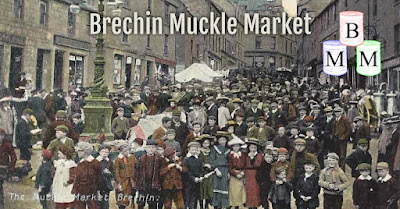
There is something about a market that is irresistible and
I’m sure, like me, many of you make a beeline for markets wherever in the world
you are, whether that be a Moroccan Souk, a middle east bazaar, or a local farmers’
market. I’ve bought jewellery from market stalls in Italy, Malta, Spain, and
many other places. I still have silver earrings I bought in Yugoslavia a few
years before war ravaged the country. In case I haven’t mentioned it, I have a
weakness for earrings.
 |
| St Jacob's Market, Canada |
The largest market I’ve visited over the past few years was St Jacob’s Market in Ontario, Canada. If any market deserved the name of muckle market, it is surely this one with masses of outside stalls where a wanderer could easily get lost and an indoor market on two levels. Food and produce downstairs and crafts and artisan goods upstairs. A market-goers paradise.
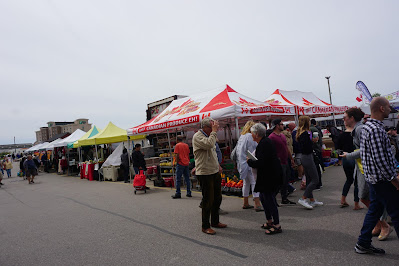 |
| St Jacob's Market outdoors |
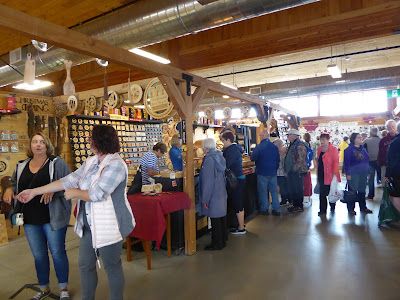 |
| St Jacob's market, Crafts section upstairs. An Aladdin's cave of goodies. |
I love to wander around markets whether they are indoors or outdoors. The stalls vary from those selling food to the ones selling all kinds of crafts. And you can always tell when you’re in the vicinity of the fish stall by the smell.
Some indoor markets nearer to home, like the ones in Bristol
and Newcastle, are permanent fixtures. The stalls trading in much the same way
as the shops on the High Street. And, if they’ve ever visited it, who could
ever forget The Barras, Glasgow’s outdoor market. Then there are the markets
which set up frequently, some once a month like the various farmers’ markets up
and down the country. Some more seasonal, like the Edinburgh Christmas Market
and the various town markets marking specific dates like the Valentine’s Muckle
Market taking place the week before Valentine’s Day in Brechin, Angus. In case
you don’t know where that is, it’s in Scotland.
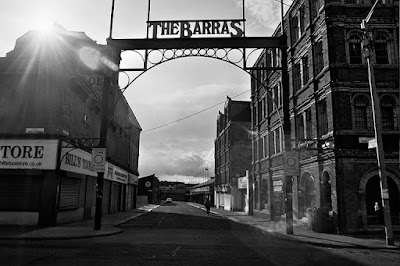 |
| Entrance to The Barras, Glasgow |
Brechin recently resurrected the Muckle Market largely through the efforts of Glen Grant and his team of volunteers. They set one up at Christmas and it was fantastic. It was in the Mechanics Hall in Brechin and spread out over two floors of the building. An ambitious undertaking that was highly successful.
So, what is a Muckle Market? Well, muckle is an old Scots
word that means big, and the original Muckle Market referred to a historical
market that was held regularly. So, basically it just means a big market.
Brechin has had markets since the Middle Ages. The right to
have a market in Brechin was originally granted by King David 1, who reigned
from 1124 to 1153 and this right was confirmed by William the Lion. This
privilege to hold a market was granted and confirmed by repeated charters over
the years and the burgesses of Dundee and Montrose were prohibited from
‘troubling the merchants of Brechin’. So, Brechin markets were exclusively for
Brechin merchants.
Over the following years, as well as the Muckle Market there
were various markets in Brechin, one for farmers, initially at the Prentice
Neuk and then at Park Road, which would be mainly livestock; the horse market
at Clerk Street; the Timber Market, frequented by Highlanders, at Market
Street; and not forgetting the Trinity Market, locally known as the Taranty
market, established in 1819. This market ran for many years, and I remember
visiting it in the 1960s when it was still going strong and had a range of
amusements as well as stalls.
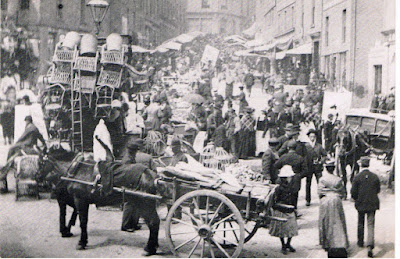 |
| Market at the Mercat Cross, Brechin |
As for the Muckle Market. This was originally in St Ninians Square, a short distance from the railway station. As its name suggests, it was a big market. It was also a hiring or feeing market. This was where farm workers came to sell their services to the highest bidders. The farmers looking for ploughmen and dairy maids would come to inspect what was on offer. The women would line up at one side and the men at the other to be inspected by the farmers looking for workers. Once a deal was struck, the worker would be hired for a year or half-year. I can’t help feeling it must have been a somewhat similar experience to that of slaves being put on display at a slave market.
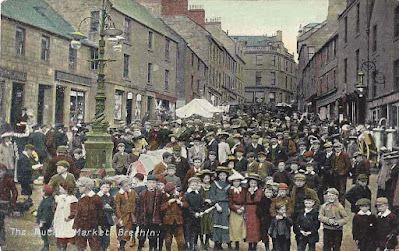 |
| Brechiners meeting at the Mercat Cross, the main hub of the town |
Although the main business at these markets was the hiring of workers, it was also a day out with amusements and stalls and, on the completion of business, attention would turn to sampling everything on offer.
 |
| Mechanics Institute, Brechin. New hub for the Muckle Market |
As I said previously, the revival of the Muckle Market in Brechin at Christmas was an all-round success and I’m now looking forward to the Valentine’s market which takes place on Saturday 5th February and Sunday 6th February at the Mechanics Hall in Brechin, with all sorts of goodies on offer. And I assure you that with over 32 stalls in the building it will live up to the name of Muckle Market, although I can’t guarantee we’ll be hiring out ploughmen or dairymaids.
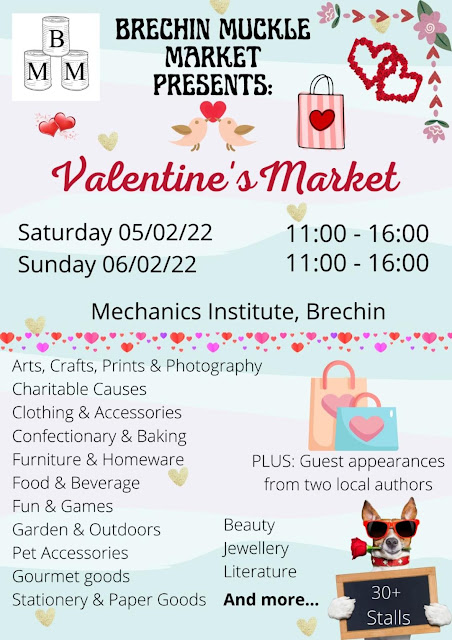
Check out the Brechin Muckle Market Facebook page and see what it’s all about.
Chris Longmuir

Tonight, I’ll be the despair of all my Scottish ancestors. I’ll
be going to my bed and sleeping the old year out and the new year in. I won’t
even stay up to hear the bells and drink the toast to welcome the new year. When
you’re the only one in the house, there seems little point. Not like the old
days when we might go on the razzle for days on end.
Why should it matter? Well, in Scotland Hogmanay and New Year
have always been the biggest celebration. Far bigger than Christmas. In fact,
Christmas was never an official holiday in Scotland until about 1958. It was only
after that date Scots were allowed a day off work at Christmas and that has
built up over the intervening years to be the same as the English holidays, two
official days. But New Year has always had its full quota of holidays.
When I was a child, everyone worked on Christmas Day, but
like most other children in Britain, Santa did come on Christmas Eve and we
hung our stockings up, hoping for them to be filled. But I recall some children
who did this at New Year, particularly if their parents were from the older
generation.
I suppose the situation in Scotland was a hangover from the Scottish
Protestant Reformation, John Knox and all that jazz. In fact, Christmas was
banned in the sixteenth century due to the views of influential reformers that
it was a Popish or Catholic feast.
So, back to Hogmanay and the New Year, the biggest Scottish
celebration when everyone celebrates with a dram. Being Scots, alcohol and
celebration go hand in hand.
It was certainly a riotous time when I was in my teens.
Everyone bought a bottle, even the girls. The men would have their whisky or
rum, maybe both, if they had enough money, while the girls settled for port or
sherry and, in some cases, if you really wanted to splurge, cherry brandy.

Armed with our bottles, we would sally forth before midnight to the town square to wait for the bells. When midnight tolled (the bells), bottles would be opened and offered to all and sundry. Everyone taking a swig from the bottle offered. No concerns about germs in those days. We would link arms, sing, dance, and kiss strangers. Thinking about it, an orgy couldn’t have done any better.
This would go on for about half an hour and then we would be
off to first foot all and sundry. In those days, people kept open house for any
reveller who knocked on their door. You were meant to first foot people with a
gift of some sort, a lump of coal preferably for luck, although most young folk
just offered a swig from their bottle. And, of course, it had to be a dark-haired
person who was the first foot, otherwise it was bad luck.
I remember my gran always had soup and steak pie for her
first footers. Anyone through the door after midnight was given a seat at the
table and a generous helping of both. After everyone ate, they retired to the
best sitting room where my aunt played the piano and a friend the accordion. It
was singing and dancing until the early hours, then we would be off to see who
else we could first foot. There were times when the first footing lasted all of
three days. We were hardy back then.
So, now you see why my ancestors will despair of me when I
retire to my bed without even waiting to hear the bells.

Happy New Year everyone.
Chris Longmuir

Last Christmas I wrote about Christmas in the strangest of
years. Well, it’s still a strange old world and while I’ve occasionally been
venturing out from my hermit’s cave, it certainly doesn’t feel normal.
I now visit a few select shops but am still shunning all
supermarkets. Delivery to my doorstep is the new norm. As for travel, I don’t
think I’ve been further than 30 miles from my own doorstep for the past two
years. Book festivals and conferences are a no-no unless they’re online. I’ve
become quite adept at Zoom and have done a few Zoom events and readings for
libraries and other places. If you search for my name on YouTube, you’re bound
to find them.
I have plucked up the courage to do some live events, as
well as taking my bookstall to various markets. Masked and sanitised, of
course. And it’s been marvellous to meet real live people and readers in the
flesh rather than on Zoom. I think I’d started to think flesh and blood people
were a figment of my imagination and that we were all avatars.
The one good thing is that I’ve read a massive number of
books. Kindle for bedtime, paperback or hardback for midday, and audiobooks
when I’m exercising or doing mundane household tasks.
I will be dining out on Christmas Day, but it won’t be in a
restaurant or hotel – I’ve forgotten what the inside of those looks like! I
will be joining my granddaughter and her family, maintaining my social bubble,
and we’re going to have a great time.
As for the new book, it’s progressing slowly. I think when
lockdown first happened, my brain decided to go into lockdown as well. I really
must get my finger out and finish it.
In the meantime, I want to wish everyone a happy Christmas
and to those of you who don’t celebrate Christmas, happy holidays. I hope Santa
is good to you and fills your stockings with all kinds of goodies, particularly
books. What’s Christmas or a holiday without a good book.

Chris Longmuir

I haven’t seen writing friends in the flesh for a year and a
half and I was delighted when thriller writer Alison Morton and I agreed the
other day to meet up in person at the next CrimeFest in 2022. But neither of
us have been idle – writers are used to a certain measure of self-isolation.
Alison has spent her time writing a sequel to the first in
her new Mélisende series. Although she’s written Double Pursuit (publication
date 19 October) as a standalone as all her books are, it follows on naturally from
her first book, Double Identity.

In this new book, protagonist Mel is investigating a loose
end from a previous case. And her efforts are going nowhere. At least, that’s
what she thinks. Here’s a bit more about Double Pursuit:
One dead body, two badly injured operatives and five
crates of hijacked rifles.
In Rome, former French special forces intelligence analyst
Mélisende des Pittones is frustrated by obnoxious local cops and ruthless
thugs. Despite the backing of the powerful European Investigation and
Regulation Service, her case is going nowhere. Then an unknown woman tries to
blow her head off.
As Mel and fellow investigator Jeff McCracken attempt to get
a grip on the criminal network as well as on their own unpredictable
relationship, all roads point to the place she dreads – the arid and remote
African Sahel – where she was once betrayed and nearly died. Can Mel conquer
her fear as she races to smash the network and save her colleague’s life?

Who are Mel and McCracken?
Mélisende des
Pittones (Mel) is the daughter of a French father and English mother and
currently on detached duty from the French Army special forces as an
intelligence operative for the European Intelligence and Regulation Service.
She comes from a privileged
French background but is down to earth and has declined promotion to officer
status several times. Her secret fear? Failure.
Jeff
McCracken is an ex-London Met inspector who Mel was obliged to work with in Double
Identity. Leaving his violent father and the petty criminal environment of
his childhood on a bleak council estate behind him, he joined the police
service at eighteen. He’s not Mr
Sensitive, but is intelligent, competent and persistent. He has a fairly large
chip on his shoulder and tries to hide it, but his old insecurity leaks out now
and again.
Mel and Jeff’s backgrounds and values tend to clash despite
their personal and professional closeness. Sometimes, those differences are the
key to pursuing villains...
You can buy Double Pursuit here:
Amazon: https://mybook.to/DoublePursuit
Kobo: https://www.kobo.com/fr/en/ebook/double-pursuit
Apple: https://books.apple.com/gb/book/double-pursuit/id1585547953
B&N Nook: https://www.barnesandnoble.com/w/double-pursuit-alison-morton/1140156361?ean=2940162379614
Paperback: https://www.alison-morton.com/books-2/double-pursuit/where-to-buy-double-pursuit/

Connect with
Alison
Her World of
Thrillers site: https://alison-morton.com
Facebook author
page: https://www.facebook.com/AlisonMortonAuthor
Twitter: https://twitter.com/alison_morton @alison_morton
Alison’s writing
blog: https://alisonmortonauthor.com
Goodreads: https://www.goodreads.com/author/show/5783095.Alison_Morton
Newsletter sign-up: https://www.alison-morton.com/newsletter/

Social media, like it or loathe it, is part of many of
our lives. I must admit, I am not the most active person on social media but I
pop in and out of Facebook and like many writers I follow a variety of writers’
groups, most of them with a distinct leaning towards self-publishing.
I’ve been an indie author for many years, having
arrived there through the traditional publishing route after becoming
thoroughly disillusioned by the policies and practices of the aforesaid
traditional publishers. So, over the years, I’ve developed extensive experience
in all aspects of indie publishing, otherwise known as self-publishing.
Returning to social media, one thing that has struck
me recently is that many of the newer indie authors think that writing and
publishing their book is the end of the journey. All they then need to do is
market and sell their book. Few, it seems, are aware of their legal
responsibilities after publication.
On Facebook, I frequently see posts in various
writers’ groups expressing concern at the receipt of a request for their book
to be sent to the Legal Deposit Libraries. The authors concerned are usually
asking whether this request is genuine and whether anyone else has received one.
Responses often vary from ‘ignore it’; ‘it’s a scam’;
and even ‘if they want my books, they can buy them like everyone else’. This
type of comment often outweighs the few comments which give accurate
information.
This kind of social media interaction highlights the
lack of knowledge that a fair number of indie authors have about their legal
responsibilities to provide copies of their self-published book for legal
deposit.
Who is responsible?
Before I go any further, it might be best to define where the legal responsibility lies. Please note, this article refers to the
legal situation in the UK, although my understanding is that legal deposit is
required in most countries.
The legal responsibility to provide a published book
lies with the publisher of the book, not the author. But an indie author may
be, by definition, also an indie publisher depending on who has supplied the
ISBN.

It's simple really. Whoever owns the ISBN is the publisher. If the author has bought and paid for their own
ISBN, from the official ISBN agency for their country (Nielsen UK; Bowker US), then that author is also the publisher of the book to which the ISBN is
assigned. As such, the legal responsibility for legal deposit rests with him or
her. On the other hand, if an author has not purchased their own ISBN and has
accepted the free or cheap one supplied by printers and distributors such as
KDP, then that author is not the publisher and has no liability for legal
deposit. And, before you ask, I have no idea how KDP or other printers comply
with the legislation, if at all.
You can find most of the information on the British Library website.
The Legislation
This is what Section 1 (1) of the Legal
Deposit Libraries Act 2003 says:
"A person who publishes in the United Kingdom a work
to which this Act applies must at his own expense deliver a copy of it to an
address specified (generally or in a particular case) by any deposit library entitled
to delivery under this section." (quote)
Section 3 of the act deals with enforcement if the
publisher has not complied with the legislation, which allows the deposit
library to apply to the court to force the publisher to comply. However, in my experience,
I have never known this to happen, although that doesn’t mean it hasn’t
happened or it won’t happen.

The Legal Deposit responsibility
The legislation states under section 4 that you must
send one copy of your book to the British Library within one month of
publication. They do not request it. It is the publisher’s responsibility to
ensure this is done. However, if they receive no copy of your book, they will
send a notification to remind you of your statutory duty. It is this notice
that elicits the Facebook response I previously mentioned.
Section 5 of the legislation states that each Legal
Deposit Library, other than the British Library, is also entitled to a copy of
your book. But they must make this request. Therefore, you are under no
obligation to send these five copies until you receive a request for them. Once
you receive this request, you must send five copies of your book to the Agency
for Legal Deposit Libraries within one month.
After receipt of your book, the Agency for the Legal
Deposit Libraries sends one copy of it to the five Legal Deposit Libraries.
These libraries are – the Bodleian Libraries of the University of Oxford;
Cambridge University Library; The National Library of Scotland; the Library of
Trinity College, Dublin; and the National Library of Wales.
What happens to the books?
I have noted there is some general confusion about
what happens to these books because of a misunderstanding of the role of the
British Library and the Legal Deposit Libraries. It is not uncommon for the
assumption to be made that these libraries operate like your local library and
the books are there to be loaned to the public. However, this is not the case.

The books supplied for legal deposit are added to the archives of all books ever published in the UK. These publications become a research resource and are included in the deposit library’s online catalogue for the availability of users who can inspect the books within the deposit library premises.
As long as these archives exist our books will be there long after we are gone. Possibly the only chance of immortality we will ever have.
Word of warning
Do not make the mistake of combining the six books for
the British Library and the Agency for the Legal Deposit Libraries into the
same delivery. I did that once, sending all six to the British Library. The
five books intended for the Agency for the Legal Deposit Libraries went into limbo, never
to be seen again and I had to send a further five copies to the Agency for the
Legal Deposit Libraries. That is because the British Library is based at Boston
Spa, Wetherby, while the Agency for the Legal Deposit Libraries is based in
Edinburgh.
Conclusion
Now that you have waded through this article, I trust
you have a clearer understanding of the subject of legal deposit and are able
to work out whether you are liable.
Do not despair though, because there are some other
things you can do after publication that will hopefully bring some small amount
of additional money to you. Registering for PLR (public lending right), for
example, and joining ALCS (the Authors Licensing and Collecting Society).

I will end by saying the journey to self-publication
is not an easy one and there are more aspects involved with publishing than
simply writing the book and uploading it for publication. That is why I devoted
an entire chapter in my book ‘Nuts & Bolts of Self-Publishing: How to
Self-Publish Ebooks and Paperbacks’ to what you must do and what you can do
after publication of your book.

Chris Longmuir

BLURB
An unexpected murder. A suspect with a reason. The power of unwavering belief.
A murder has been committed in an office in Jerusalem. That’s for sure. The rest is not as clear-cut as it might seem.
Asaf languishes in his cell, unable to tell his story even to himself. How can he tell it to someone who elicits such fear within him?
His colleague, Nathalie, has studied Beauty and the Beast. She understands its moral. Maybe that’s why she’s the only one who believes in Asaf, the suspect. But she’s new in the company – and in the country. Would anyone take her opinion seriously?
She coerces her flatmates, Yarden and Tehila, into helping her investigate. As they uncover new trails, will they be able to reverse popular opinion?
In the end, will Beauty’s belief be strong enough to waken the Beast? Or, in this case, can Style waken the Solitary?
EXCERPT
CHAPTER ONE
Winter jacket with hood, gloves in pockets. Asaf gave his black shoes an extra
little polish. Then he checked his image in the wardrobe mirror and felt around
in his pockets. Keys, phone, wallet with Rav Kav, ID card, credit card and
money. And the note, written last night, folded twice. He rubbed his thumb and
forefinger against its smooth surface. The rubbing gave him courage,
determination, like the touching of two wires to complete an electric circuit.
Nothing would put him off, this time. Nothing and no one.
Asaf turned the key to unlock the front door, using his foot to push aside the
draft stopper. When he returned, he would have done the deed and things would
be different. Yes, people were about to take notice of him. Change was in the
air.
The cold wind hit him as soon as he stepped out of the flat. This block didn’t
have an outside door, and living on the ground floor didn’t help. Outside the
building, the wind swirled around him. Asaf cut through it with hooded head
lowered, as he charged ahead along almost-deserted pavements. He passed closed,
lifeless shops. Even the grocer, though open for business, had its entrance
closed to keep the weather out.
Other early birds waited at the bus stop on Hebron Road. Asaf recognised most
of the faces and some of the voices. They probably recognised him. One thing he
was sure of: none of them had ever heard his voice. He’d never approached them,
and they usually left him alone. There was that time when a newcomer had asked
him which bus he needed to get to the central bus station. He shrugged and
raised his eyebrows, despite knowing the answer, and someone else offered the
information.
The 71 turned up and most of those waiting crowded around the entrance. Asaf
stood at the back, where no one would blame him for shoving them. There were
generally enough seats, anyway, at this time. If not, standing was no hardship
for him. As usual, he was the last to insert his Rav Kav into the slot.
This time – was this a sign? – he even won a prize for being last on. A window
seat, vacated when two people prepared to get off at the next stop. A chance to
get up to date with news headlines on his phone, as well as to glance up at the
familiar sites passing by. The Bank Junction, nicknamed after the numerous bank
branches. Its name had stuck, although several of them had since changed
identities. The streets of the neighbourhood of Baka on the left, then Abu Tor,
the mixed Jewish and Arab neighbourhood, on the right. The First Station, once
Jerusalem’s railway station, now an outdoor cultural and culinary centre that
hosted shows and boasted the start of a walking and cycling path leading as far
as the zoo. Yemin Moshe, the beautiful old, road-free neighbourhood easily
identifiable by its tall windmill. The town centre, and then the orthodox
areas, noticeable especially by the dress of those traversing the streets,
chatting together or scampering in all directions.
Perched on his window seat, Asaf took in all these sites, and skimmed the news
on his phone, but still focused on his self-imposed mission for today. Nothing
could stop him. Not
after the events of Thursday, the last working day before the weekend. Thursday
was a bad day, but sometimes you needed bad things to occur because they pushed
you to break out of your comfort zone. Like the time he hit back at some twerp
at school, who fell down in surprise, and for a change the laughter had
diverted from Asaf to the twerp.
The screen on his phone turned itself off, but Asaf continued to stare at it.
Thursday. It was about eleven when he found out – after everyone else,
naturally. He’d been concentrating on a particularly difficult circuit board,
trying to work out the best components to fit into a tiny space, and he’d just
had a lightbulb moment when Ido had put his black-haired head round the opening
to Asaf’s cubicle, all smiles and false friendliness. Typical. Ido always
appeared at the worst moments and commanded attention solely by his presence.
Asaf should have told Ido to wait because he was busy. He should at least have
said he needed another minute, so that he could write down his lightbulb
thoughts before shifting his attention to Ido. But he didn’t. He never did. The
truth was – and this was hard to admit but had to be said – he was in awe of
Ido.
Yes. Ido, who was hopeless at his job in quality assurance. Ido, who said,
“Yes, of course I understand.” Ido who came back to Asaf to ask yet again and
feigned friendliness until Asaf had practically run the whole procedure
himself, because there were only so many times you could explain the same
thing.
“Asaf, you’re a brick. I’m indebted to you. I’ll tell Omer how helpful you’ve
been to me.”
Like hell you will, thought Asaf. You’ll never tell the boss I did your work
for you. You’ll pretend it was all you, and he’ll believe you because you could
talk your way out of a snake pit. You could persuade a murderer to release you
from the knife on your neck. And you know I won’t tell Omer, despite being
absolutely exasperated with you, because it would be too much of an effort for
me to get the words out. Omer wouldn’t believe me anyway. I know that and you
know that. It’s win-win for you and lose-lose for me. Every single bloody time.
Yes, this was that same Ido who Asaf was in awe of, precisely because of his
ability to use his tongue to get everyone on his side.
But on Thursday, Ido hadn’t come with any of his scribblings in hand or asked
Asaf to review any of his measly attempts. No, Ido had come with an excited
grin between his spiked hair and neatly trimmed beard, and a piece of news.
“Guess what. I’ve been promoted!”
“What!” Even Asaf couldn’t keep quiet at that.
“I know; I was amazed, too. They think I’m ready to manage a team and, with
Koby in the
other office leaving, there’s one going. Isn’t that wonderful?”
“Yes. Congratulations.” Asaf’s reply was weak and emotionless, but that
wouldn’t raise
any eyebrows. Asaf always sounded quiet and lacking in feelings.
“Cheers, mate.” Ido thumped Asaf on the back. “I’m ordering cake for this
afternoon. Two
o’clock. Don’t forget.” Ido’s actions were apparently friendly, but Asaf sensed
the underlying scorn. What Ido was really saying was, ‘Huh, you see? You sit
here glued to your desk, slaving away at your simulated designs with their
intricate components, but I’m the one who gets promoted. I’m the one who’s
going to get ahead in life. Ten years from now, I’ll be a big boss over a whole
department or a whole company. I’ll have a large office all to myself, and
you’ll still be sitting in your little cubicle taking commands from up above.’
Asaf had lolled back in his chair after Ido left him. He’d been working at the
office longer than Ido, he was far, far better at his work than him, and he
would never be promoted.
https://www.amazon.co.uk/Style-Solitary-Jerusalem-Murder-Mystery-ebook/dp/B08X7GG82V

Miriam Drori was born and brought up in London and now lives with her husband and one of three grown up children in Jerusalem.
With a degree in Maths and following careers in computer programming and technical writing, Miriam has been writing novels and short stories since 2004. After some success with short stories, Miriam turned her hand to longer fictional works, publishing NEITHER HERE NOR THERE and THE WOMEN FRIENDS: SELINA, co-written with Emma Rose Millar.
Social anxiety features in Miriam's latest publications. SOCIAL ANXIETY REVEALED is a non-fiction guide that explores this common but little-known disorder from multiple points of view. The book has been highly recommended by 'sufferers' as well as professionals in this field. CULTIVATING A FUJI is the story of a fictional character who battles against social anxiety before learning to make friends with it. STYLE AND THE SOLITARY, a crime novel, asks an important question: what happens when a suspect can't stick up for himself?
When not writing, Miriam enjoys reading, hiking, dancing and travelling.
Facebook
https://www.facebook.com/miriamdroriauthor/
Amazon page:
https://www.amazon.co.uk/Miriam-Drori/e/B00L11J6D
Goodreads
https://www.goodreads.com/author/list/4829682.Miriam_Drori
https://www.pinterest.co.uk/miriamdrori/
Twitter
https://twitter.com/MiriamDrori
Instagram
https://www.instagram.com/miriam.drori/
Wattpad
http://www.wattpad.com/user/MiriamDrori

