Total Pageviews

Sunday, 24 February 2013

What is Tartan Noir?


(This post was originally published on the Authors Electric site "Do Authors Dream of Electric Books?)


You’ve probably come across references to Tartan Noir on the internet and various other places, and if you walk into a bookstore in Scotland, the chances are you’ll see a display labelled Tartan Noir. But what is Tartan Noir?

The name is an odd mix. The tartan part of the name smacks of tourism, kilts, heather and bagpipes, all the stuff that attracts people to Scotland, although it is not all that relevant in today’s modern world. The second part of the title –Noir – is more reminiscent of blood and gore, and all the horrible things that happen in the darkest of crime fiction. So it is an odd mix indeed.

It was actually James Ellroy who coined the name when he referred to Ian Rankin as the King of Tartan Noir in the 1990s. Since then it seems to have been taken up to describe Scottish crime fiction in general, and has now been given historical antecedents.

The origins of Tartan Noir in Scottish literature are claimed to be rooted in the works of James Hogg, Robert Louis Stevenson and William McIlvaney.
 

James Hogg’s Confessions of a Justified Sinner, written in 1824, seems to be the earliest influence. This novel has been variously described as a psychological case study; a gothic novel with elements of horror; a satire of extreme theology; plus an early example of crime fiction. It is said to be the earliest example of a novel using an alter-ego, and involves a battle between good and evil. It is considered to be an influence on Robert Louis Stevenson’s Jekyll and Hyde, as well as James Robertson’s novel, The Testament of Gideon Mack, and various others.

Jekyll and Hyde, written by Stevenson in 1886 uses split personality, and continues the theme of the battle between good and evil. He claims the idea came to him in a nightmare and he called it ‘a fine bogy tale’. In her essay The Dark Threads of Tartan Noir, Carole E. Bannerman writes –

‘Like every noir writer since then, Stevenson situates evil in the heart of man, and then places that man in the heart of a city. The city becomes a manifestation of the moral hypocrisy and the mock respectability that the noir writer attacks.’

Tartan Noir was also heavily influenced by American writers such as Dashiell Hammett, Raymond Chandler, and James Ellroy, who were all writing hard-boiled detective fiction, and many Scottish authors followed in their footsteps, probably beginning with William McIlvaney, who has been termed the Godfather of Tartan Noir, a title that bemuses him. When he wrote Laidlaw, he said he had no intention of writing a crime novel. He wanted to write a story that was real, not one where the book was taken up with a murder and whodunit. It just happened that the character he chose was a detective with a troubled past and present.

Many Scots have a fascination for gruesome events, particularly those that have happened in the past, therefore it is not surprising that Burke and Hare, the body snatchers who operated in Edinburgh between 1827-1828, and Deacon Brodie, a respectable town councillor by day and a housebreaker at night, are considered influential in the rise of the type of dark writing labelled noir. In fact, Deacon Brodie is considered to be one of the influences behind the writing of Stevenson’s Jekyll and Hyde.

So where does that take us in defining Tartan Noir? Is it the broad sweep of Scottish crime fiction, or is it a subset of hard-boiled and dark crime, that takes the reader to a dark and scary place?

Maybe if we look at the issues Tartan Noir novels explore, that will help us decide. These include psychological and socio-economic issues, hard-boiled crime, and dark crime. The characters are invariably flawed, often with split personalities and they are anti-heroes rather than heroes. So does this rule out cosy crime? And how dark does dark crime have to be? Or is it safer to include all Scottish crime? I don’t know. Do you have an opinion?

Oh, and before I go, would anyone like to comment whether I fit into the Tartan Noir category with my Dundee crime series of books? I’d love to know.


Thursday, 10 January 2013

Do You Become Your Characters?


One of the fiction writer’s jobs is to create characters, and I’m sure we all do it in different ways. Some writers create a biography for their character before they ever put pen to paper to write their story. Some writers may model their characters on people they know, taking a little bit here and another bit there and amalgamating them into a new character. Some writers start the book first and let the character grow out of the narrative. I could go on and on.

However, it was something Cally Phillips said in a recent blog which was ‘walk a mile in their shoes’ in order to understand someone, and this applies to characters as well as people.

Anyway, Cally’s comment got me to thinking, because when I’m creating characters I like to get inside their heads, and I like to walk in their shoes. Oh, I do all the other things as well, but there’s nothing quite like getting inside someone’s head to really get to know them.

Mind you, a lot of my writing can be scary and my characters are not always likeable, so the inside of their heads is not a comfortable place to be.

Take the Night Watcher, for example. I lurked in dark corners with him, spied on his chosen one, and shared his delusions. Inside his head was a really scary place to be and if I had exhibited schizoid tendencies when I was writing this, it wouldn’t have been surprising. Julie, the main character in this book started out as a nice person, and I shared her grief when she lost her husband. The self harming wasn’t particularly nice, but it was part of who she was and how she coped. But then she became so eaten up with thoughts of revenge on the woman who stole her husband and ultimately led him to his death, she changed. She had some rather nasty thoughts, and I became involved in the psychological games she played on Nicole, who was the other woman. Nicole was selfish, ambitious, and liked other women’s husbands, but she also had her vulnerabilities. So, all in all, none of them were very pleasant heads to be in.

Kara, in Dead Wood, was another head it wasn’t always comfortable to be in. I was with her in the woods with the serial killer and shared her fear and despair. I ran from Tony’s thugs as well as the killer, and understood her desperate need to rescue her children from the care system, which was something that kept her tied to Dundee and was ultimately her undoing. Sharing her street walking experiences, her run in with the serial killer, and her panic at being hunted by Tony’s thugs was distinctly uncomfortable.

Then there’s Bill Murphy, who appears in Night Watcher and Dead Wood. I was there with him in the snake room as well as his own neglected flat. I shared his despondency, his heartburn, his doubts and fears.

You would think that Belle’s head in A Salt Splashed Cradle would be a nicer place to be, because it’s a historical saga and Amazon promotes it in their newsletters as a romance. Well I suppose it is a romance, just not a very soft, sweet one. So back to Belle’s head, if you think it would be nice to be there, you’d be wrong. You see Belle has her problems. She wants the romance and the happy ever after, but it’s not in her nature to have that. So I shared her ostracism by the villagers, her sexual encounters with the Laird’s son, and lots of other stuff. Then there was Jimmie, her husband. I sailed with him on the fishing boat and then the whaler. I sailed to the Arctic seas with him, climbed the masts and furled and unfurled the sails with him. I chased whales with him, shivered with him, shared his frostbite, and his love for Belle. And of course, there’s Sarah, who cannot understand why her mother does not love her.

Then there’s my short stories. I’m not even going to go there, too scary.

So I come back to my original question – Do you become your characters? Or do your characters become you? Oh, and how do you get back out of their heads again without losing your mind?

(This post was originally published on the Authors Electric site "Do Authors Dream of Electric Books?)


Monday, 31 December 2012

Happy New Year


Hogmanay and New Year is a time of celebration in Scotland and I would like to include you all in my celebrations.

So I would like to raise my glass to you and wish all my readers and followers a Happy New Year, and I hope 2013 will be a year of joy and delight for you all. I've appreciated your company, and your interest in me and my books, and I can only hope I can meet your expectations over the coming year.

So here's to you - a Happy New Year and many of them.

Chris Longmuir

http://www.chrislongmuir.co.uk/


Amazon UK

Amazon US


Tuesday, 4 December 2012

Who invited the Night Watcher to the party?


Bill Murphy turns the invitation over, trying to see who has sent it, but all it said was, ‘Meet me at Donovan’s at 7pm’. He snorts and throws it into the waste bin. He isn’t in the mood for the pub tonight, and he’s sworn off the drink. But curiosity gets the better of him, and he fishes the gilt edged card out of the bin, and now here he is, outside Donovan’s.
 
The noise hits him as soon as he opens the door, and the place looks different. It’s like New Year's Eve, with balloons and bunting everywhere. Someone releases a party popper, and the paper streamers erupt over his head.
 
‘I knew you’d come.’ Sue does a little jiggly dance in front of him.
 
‘What’s the celebration?’ Bill accepts the glass she thrusts into his hand.
 
‘You mean you don’t know?’ Sue throws up her hands in mock horror and produces a book. ‘Why, it’s the launch of Night Watcher in paperback.’
 
‘So what’s so important about that?’
 
‘You, mate. It’s where you were born, inside the pages of Night Watcher.’
 
‘But Night Watcher’s been on ereaders for yonks now, so why are we celebrating the paperback?’
 
‘Don’t you think it’ll be better for you if the pages can be turned as paper, instead of being poked with a finger?’
 
Bill shrugs. ‘I’ve been in paper before. I was in Dead Wood, remember?’
 
‘Ah, but Dead Wood wasn’t your birthplace. You were born in Night Watcher, and we’re celebrating your birth in print.’ Sue removes the umbrella stick, and sips the blue coloured concoction in her glass. ‘And everyone’s here to celebrate with you. Look, there’s Julie over there, you like her, don’t you?’
 
Bill looks, but Julie is deep in conversation with a guy who has a rope dangling round his neck.
 
A surge of jealousy courses through him. ‘Who’s that with her?’
 
‘That’s her husband, Dave. Nice looking guy, I could go for him.’
 
‘But didn’t he die in Chapter Two?’ Bill stares, he’d never seen the guy when his face wasn’t distorted.
 
‘Yeah! But he said he liked a good party and didn’t want to miss it.’
 
Bill looks round the room. Everyone is here, right enough. Nicole and Scott are seated in the corner. Bill is tempted to go over and speak to them but he isn’t sure if they know what is in store for them and he doesn’t want to provide them with any spoilers. Better they don’t know anyway.
 
‘Hang on a minute, Sue. Who’s that hooded chap over in the corner, the one sitting on his own, the weird looking guy?’
 
Sue looks over the rim of her glass. ‘Oh, him, that’s the Night Watcher. I had a bit of a job convincing him to come, but I felt he should be here, it’s his story as well. But it’s better if he’s left alone, he’s not very sociable.’
 
‘This is the weirdest party I’ve ever been at,’ Bill grumbles, taking a sip of his whisky. ‘Why am I drinking this stuff? I don’t like whisky. I wish someone would give me a rum and coke.’
 
‘That’s something you’ll have to take up with your creator. Oh, and speaking of the devil, here she comes now.’
 
‘Damn and blast, she’s bound to spoil the party.’
 
‘What happened to the “F” word you’re so fond of using?’
 
Bill shrugs. ‘Well it is a celebration and we are appearing on Chris’s blog, so I’m on my best behaviour.’
 
Sue snorts into her drink. ‘Best behaviour? Now I’ve heard it all.’ She looks up. ‘Watch out, here she comes.’
 
Bill looks moodily into his drink. ‘Yeah, Miss Goody Two Shoes, the party will go downhill from now on. She doesn’t smoke, doesn’t drink, doesn’t even swear, although she puts plenty of swear words into my mouth.’
 
‘Shh, she’ll hear you. Remember she has the power of life and death in those fingers of hers.’
 
Bill shudders. ‘Yeah, we spend our days hunting for killers and she’s the biggest killer of them all.’
 
Bill looks up and smiles. ‘Hi Chris, glad you could join us. D’you think you could sign my book?’ He produces the copy of Night Watcher that Sue had given him earlier.
 
‘Just put, Bill, the great detective.’
 
Sue chokes on her drink and turns away to hide her smile.
 
****

I hope you’ve enjoyed the party, and now I’ll tell you a little bit about Night Watcher. But first, I have an invitation for you to attend the launch. It's over on loveahappy ending.com and I'd love to see you there.

 
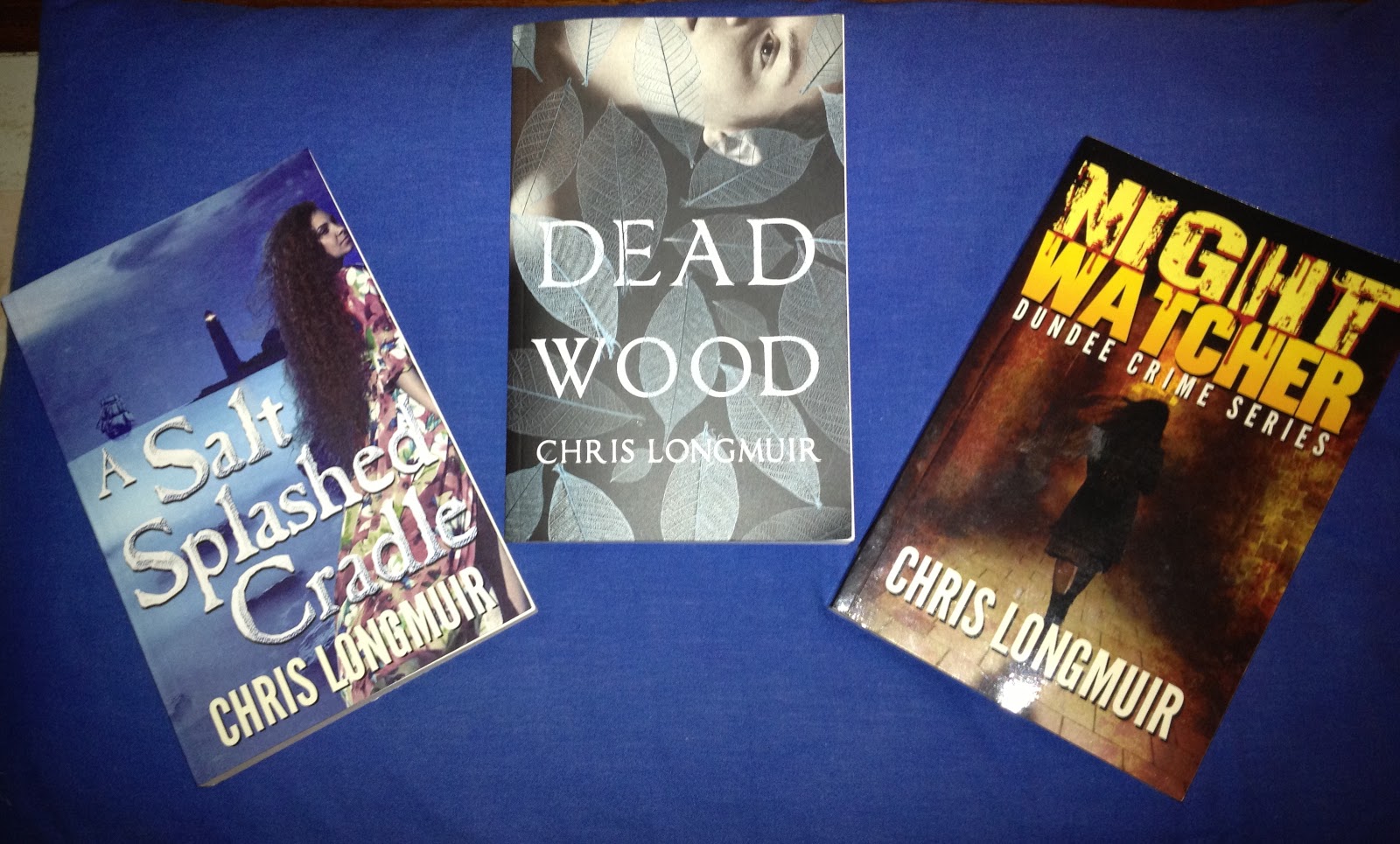
 Night Watcher is the first book in my Dundee Crime Series, although the second book in the series, Dead Wood, was actually published first. So in some ways you could call it a prequel, although I prefer to say it’s the first in the series.
 
A large part of the action takes place in Drake's department store, which Christopher Brookmyre felt was a gothic setting with a character all of its own.
 
The main character in Night Watcher, is Julie who is devastated when her husband Dave is found dead. She blames Nicole, the woman he left her for and seeks to destroy her life in the same way she thinks Nicole destroyed Dave.
 
The main police character is Detective Sergeant Bill Murphy, however in my books the police are secondary characters to the victims and the bad guys.
 
Here is a look at the cover and how the book is described on Amazon:-


Two stalkers - one target

A mysterious stranger arrives in Dundee, with a mission to find a new Chosen One to punish. He selects Nicole, a woman with a weakness for men.
 
One of Nicole's paramours is found hanged and everyone assumes he has committed suicide. However, his estranged wife, Julie, knows better and blames his death on Nicole. Obsessed with the need to punish Nicole, Julie stalks her, unaware that there is another stalker, the deranged and dangerous Night Watcher.
 
Who will exact punishment on Nicole first? What price will Nicole have to pay for her misdemeanors?
 
Will Julie's mind games drive Nicole over the edge? And what price will Julie have to pay for her obsession.
 
Only the Night Watcher knows!
 
Night Watcher is the first book in the Dundee Crime Series -Dead Wood is the second.

Review quotes:-

Night watcher is the sort of novel that keeps the reader glued to its pages, frantically guessing as the plot takes numerous twists and turns. Alex Gray, Crime Writer
 
This is a complex and very well crafted tale, beautifully put together -full of a sense of foreboding, and full of menace. Catherine Czerkawska
 
Chris Longmuir is an award winning novelist as well as an established writer of short stories and articles. Night Watcher won the Scottish Association of Writers' Pitlochry Award, and the sequel, Dead Wood, won the Dundee International Book Prize, as well as the Pitlochry Award.
 
Amazon UK


Amazon.com


Web site –  http://www.chrislongmuir.co.uk/


Twitter –  @ChrisLongmuir

UK Launch:- http://loveahappyending.com/bells-whistles-flags-banners-for-night-watcher/

US Launch:- http://www.stephaniekeyes.com/book-launch-the-night-watcher-by-chris-longmuir-chrislongmuir/


Friday, 23 November 2012

Happy Reading – It’s Book Week in Scotland


This is what the Scottish BookTrust says – Book Week Scotland is Scotland's first national celebration of books and reading, taking place from 26 November to 2 December 2012. The week-long programme of events is bursting with fantastic opportunities for people from all ages, interests and reading abilities, to embark or continue on a reading journey.
 
Now I’m all in favour of that, but I don’t need the excuse of a special book week to read. I’ve been reading non-stop since I was five years old. I have a very clear memory of returning from my first day at school, to tell my granny, that I could read. Of course, she didn’t believe me. After all, who on earth ever heard of being able to read after one lesson. I can’t remember whether I had been involved in books before that, maybe I had learned to read through osmosis when I was being read to. I don’t know, because I have no memories of being read to. However, in order to prove my reading ability to her, I opened my school book and read. I can even remember the first sentence in that book which was the very simple ‘The cat sat on the mat’. Nothing very ambitious there, but it was a start.
One of my favourite books was the Treasure Island one
 
So from that day forward, my nose was never out of a book. I progressed through Enid Blyton’s works, to boarding school books involving The Chalet Girls and all their exploits. Oh, how I wished I could go to boarding school and have midnight feasts and pillow fights. It was a natural progression from there to murder and mystery with Agatha Christie, before I reached my teens.
This was a naughty book at the time but would be considered tame nowadays
 
Like most teenagers (I think) I became interested in naughty books. We had a wee shop in our town called The Trick Shop, which was run by an elderly couple – well, they seemed elderly to me at the time. This shop sold all kinds of tricks and puzzles, but they also sold under the counter books. This was where I was initiated into books like Forever Amber, and Lady Chatterleys Lover, although I never really understood all the fuss about the latter, and I found it so boring that when it was banned, later on, I couldn’t bear to reread it to find out what the four letter word was.
I didn't realise these books would still be available. They could be classed as penny dreadfuls
Then I found Hank Janson in a hidden stash of my father’s books. These stories were a revelation, all about American gangsters, teenage thugs and flick knives. I was fascinated by the flick knives because I’d never heard of these before. It was only many years later I found out that Hank Jansen was a generic name for a series of writers, one of whom was Bob Monkhouse, the entertainer. Apparently he churned his share of these books out at the rate of one every two weeks for which he was paid the princely sum of half-a-crown (2shillings and sixpence, which in today’s money is 12½ pence). Who ever said that writers well well paid?
 
I grew out of the naughty books phase and moved on to horror, starting with Bram Stoker’s Dracula, then I read Frankenstein, but although I liked the former I never really got into the latter. It was only a slight jump from these horor stories to those of James Herbert. I see he has one of his books, The Secret of Critchley Hall, featuring on television at the moment. I started watching and it’s really good. Then, of course, there was Stephen King, I think I read most of his books, and Dean Koontz who is expert at writing suspense and keeping you on the edge of your seat.
 
But enough of horror. I also went through a saga phase, reading Catherine Cookson, Evelyn Hood, Margaret Thomson Davis and many others. I liked the earthy ones written about ordinary people. I never really got the taste for reading about lords and ladies, kings and queens, and the glitter and glam of some sagas.

Then I discovered dark crime, and as the years have gone on, the crime has become darker. Some of the best is written by Val McDermid, and Mo Hayder, and writers like that. Oh, and I can’t forget the American writers. I love their work. I’m reading a Jeffery Deaver book at the moment, but there’s also Harlan Coben, Michael Connolly and a score of others.
 
Lately I’ve also discovered Indie books, and some of them have been a revelation. I’ve read some very good books, although there have also been some turkeys. However, the good ones are really worth the effort of getting into. If you want to get a taste of some of these why don’t you pop over to the Indie eBook Review site, click on the Virtual Bookshelf tag and pick a category to check out some of the reviews.
 
So there you go, I’ve given you a quick walk through my reading tastes, and I am sure many of them influence me as a writer. I certainly feel that American literature has shaped my writing quite a bit, and I love writing suspense, although I sometimes take a break to write the odd saga or historical.

Now before you go, have a peek at one of my many bookselves - it's a mess, isn't it?


http://www.chrislongmuir.co.uk/


Thursday, 8 November 2012

What’s in a Name?

 
How important is the name you give your characters? And how much thinking goes into names that do not confuse the reader?
 
Why am I asking this? Well, over the past few weeks I’ve lacked a certain mobility which means I’ve had time to read over my work in progress from the beginning and do a bit of editing. That was when it struck me! I’ve given my new detective inspector the name, Kate Rawlings. So what’s the matter with that? Well, one of my other characters is Detective Sergeant Sue Rogers and, although she is not the main character, she often pairs up Detective Sergeant Bill Murphy, who is my main character.
 
So, Rawlings and Rogers, the names are too similar to avoid confusion in a reader’s mind. What to do? What to do?
 
Well, I can’t rename DS Sue Rogers, because she’s featured in both Night Watcher, and Dead Wood. So that leaves me no choice but to rename DI Kate Rawlings. And she’s not the easiest person to deal with.
Product Details
 
No problems, I hear you say, just get on with it and rename her. However, it’s not as simple as that, because characters get attached to their names, and there’s going to be a pretty big tantrum when I break it to Kate, that her name needs to be changed.
 
Product Details

Characters, you see, often make their own decisions about names. When I was writing Dead Wood, my detective constable was called Joanne. Now I like Joanne as a name, Jo for short, but Joanne apparently didn’t take to the name at all, and I found that halfway through the book she’d miraculously turned into Louise. It was decision time. Would I do a find and replace on Louise to turn her back into Joanne, or should I do the reverse. After much thinking I came to the decision that if Joanne wanted to be called Louise, then Louise it should be.
 
So I’m now back to decision time and building up the courage to tell Kate she can’t be called Rawlings. But then there’s the other problem! What the heck should I call her instead, and will she make the decision for me, or is it back to the Name Dictionaries to find a suitable one? Oh, and what if she doesn’t like the new name I choose? Decisions! Decisions!
 
How do you name your characters? And are your characters as bolshie as mine? I’d love to know.


http://www.chrislongmuir.co.uk/

Amazon Author Page
 

Wednesday, 31 October 2012

I’m Really a Wimp


Hi everyone! A special thanks to my host, Chris Longmuir, for having me as a guest today! Chris has assured me that she’s never had a guest before, so I’ll try to be a well-mannered first guest.

This is me - Stephanie Keyes
 
Okay, so let’s get on with the post. I have a deep, dark confession to make. I do. How’s that for kicking off our relationship? Anyway, here it goes. I’m a wimp. No, seriously, I am a complete wimp. After I read Chris Longmuir’s Ghost Train, I had to sleep with the lights on. You can only imagine how ticked off my husband was!

 
That being the case, the question that I get all of the time is this: How do you write such scary stuff if you’re such a wimp? Now you’re getting curious, huh? I’d hoped you would.

 
Let me give you an example. In my YA Fantasy, The Star Child, there is an Upside-Down Ocean that is filled with the souls of the unforgiven that hovers over a black hole, waiting to suck you in and make you one of them.


I’ve also got Soul Snatchers, who depress you so much that you kill yourself, after which they claim your soul. They lie in wait for any unsuspecting travelers in Faerie.

 
Oh and don’t forget the evil Celtic god that keeps appearing in mirrors and scaring the pants off of everyone. Not literally, of course.

 
Maybe there are just a few somewhat scary things in The Star Child after all. But to answer the question, here is how I can write that “stuff”.

Because it isn’t real.

 
In Chris’ brilliant books, where serial killers stalk the streets and gangs rule the land, those things can truly happen, whereas mine are a product of my imagination or pulled from mythology.

 
How can I write it? Simple. I just close my eyes and imagine the scariest possible situation. What would terrify me and how could I step that up a notch, keeping in mind that I write in the YA genre. That’s where I pull in the creepy stuff.

 
But it’s okay, because none of it is real. Right? Mmmh, can I still reach the light switch?

 
Thank you, Chris, for having me as a guest today! I am still reading Dead Wood, with the light on, and love it.

 
If you’d like to learn more about my book, The Star Child, check out the information below!

 
About the Book

The world is about to be cloaked in darkness. 
Only one can stop the night.
 
Kellen St. James has spent his entire life being overlooked as an unwanted, ordinary, slightly geeky kid. That is until a beautiful girl, one who has haunted his dreams for the past eleven years of his life, shows up spinning
tales of a prophecy. Not just any old prophecy either, but one in which Kellen plays a key role.

Suddenly, Kellen finds himself on the run through a Celtic underworld of faeries and demons, angels and gods, not to mention a really ticked off pack of hellhounds, all in order to save the world from darkness. But will they make it in time?


About the Author

Stephanie Keyes holds an undergraduate degree in Management Information Systems as well as a Master's in Education. A seasoned, facilitator, Mrs. Keyes worked in Training and Development for an international telecommunications corporation for twelve years; spending the first eight years of her career as a Software Trainer and Technical Writer and the last four working in Human Resources and Employee Development.

In May of 2012, Mrs. Keyes left the corporate world to focus on her family and her writing full-time. She also operates a freelance graphic and instructional design business, Sycamore Road Design.

Inkspell Publishing will release her first novel, The Star Child, on September 21, 2012. She is now currently at work on the second book in The Star Child Trilogy, The Fallen Stars.

Keyes lives in Pennsylvania with her husband, two children, and Riley the dog.